

|
|

Page 2 of 2:
Encourage strong growth of the threaded scion. Feed the tree well to ensure strong growth. Remove any new growth on the entry side of the thread graft to encourage maximum growth on the exit side. Do not prune the threadgrafted as this will slow thickening. There is no reason why the new branch cannot be gently wired if necessary.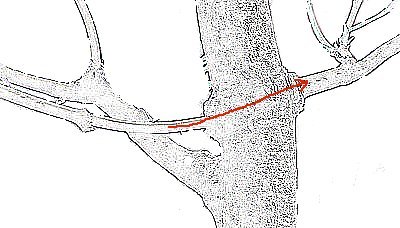
At first the new threadgraft supports itself entirely.
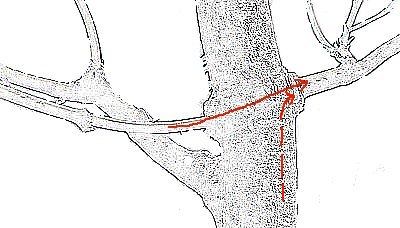
As the graft and the graft hole thicken, their cambium layers are forced together and start to merge. As they merge, the threadgraft begins to be supported by the trunk as well.
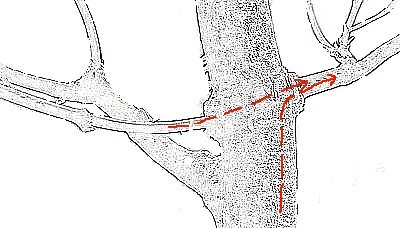
With the extra energy from the trunk, the exit side of the scion starts to grow and thicken faster than the entry side, eventually producing a pronounced increase in diameter. This indicates that the scion is being fully supported by the trunk in its new position and can start being removed.
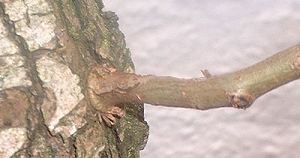
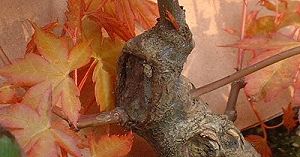
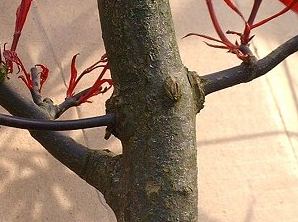
Successful threadgrafts can be seen above on a Hawthorn, Acer palmatum 'Bloodgood' and Acer p. 'Katsura'.
Severing the Threadgraft
The amount of time for the scion to reach the stage where it can be severed depends on many factors. Some species take more quickly than others, in as little time as 2 or 3 months for Ficus species (if the graft is made just before a strong flush of growth), or 2 growing seasons for slow-thickening species such as Hawthorn.
Timing of the removal or separation of the scion; it does not particularly matter at what time of year the threadgraft is separated once the threadgraft has taken but I prefer to carry out this work during the growing season while the tree and grafted branch are active and able to respond to the changes in sap-flow.
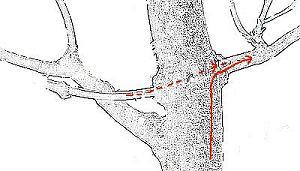
Do not detach all of the redundant side of the graft at once; the scion will still receive a little energy and be supported from the entry side of the branch. Detach the scion from the parent plant but leave a length of the donor branch in position so that the scion can slowly become accustomed to being entirely supported by its new parent trunk.
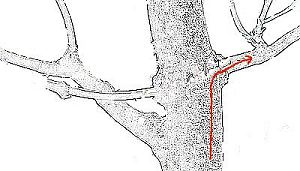
Over the course of 3 or 4 weeks, slowly shorten the donor side
until it is finally removed.
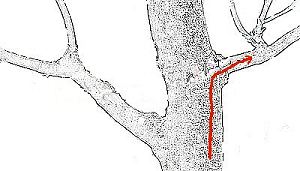
Finally, the old entry hole can be pruned flush to the trunk and allowed to heal.
Failure of a Threadgraft
Threadgrafts are most likely to completely fail if enough time is not given for the two cambium layers to join together. It is important to be patient.
There are occasions where the threadgraft is unknowingly separated too early and the leaves of the new branch droop and/or fall. This can also occur if the donor side of the thread graft is reduced in length too quickly.
In these cases, do not assume that the new branch will fail completely. I have had instances where a newly separated branch has lost its leaves but has already grafted just enough to slowly recover and issue a new set of leaves in the future.